Build: one session (10 July 2026), ~55 minutes wall-clock ·
tokens (estimated): ≈1.5M in (mostly cached context re-reads, plus
rendering and visually inspecting every chart iteration) / ≈50k out (model code,
charts, page, narrative) · model: Claude Fable 5.
Figures are estimates from the session log, not billing telemetry.
The standard history says spaceflight became possible on
16 March 1926, in a cabbage field in Massachusetts, when Robert Goddard flew the
first liquid-fuelled rocket. This essay argues the standard history answers the
wrong question. Reaching orbit never required liquid fuel — solid rockets have done
it, including one with no guidance system at all — and once you price orbit
honestly, in the only currency that matters (exhaust velocity against the rocket
equation), the ingredients were all on the shelf by about 1896. What follows is the
arithmetic of that claim: where the wall really was, which invention actually
breached it, and why the world then waited sixty-one years.
I.Orbit is a speed, and the speed was public in 1687
The first honest thing to say about a satellite is that it is not high,
it is fast. Isaac Newton made the point with a thought experiment in the
1680s: fire a cannonball horizontally from a mountaintop and it lands some distance
away; fire it faster and it lands farther; fire it fast enough and the Earth’s
surface curves away beneath it exactly as fast as the ball falls toward it — and it
never lands. Orbit is falling, sideways, indefinitely.
…click to fire the next shot
Figure 1 (animated). Newton’s cannonball, replayed. Each shot
leaves its trace; trajectories are integrated two-body orbits, drawn to scale for a
launch just above the atmosphere. The final shot, at 7.9 km/s, never comes
down. This diagram — the complete concept of a satellite — was drawn by Newton in
A Treatise of the System of the World, written in the 1680s.
Newton’s picture contains the requirement, and the requirement is a number. For
a circular orbit just above the atmosphere,
where is the Earth’s gravitational parameter (its mass
times the constant of gravitation), its radius, and
the orbit’s altitude — say 200 km, above the air. Every
quantity in (3.1) was measurable in the seventeenth century, and the answer has not
changed since. A real rocket must also pay tolls on the way up — it spends thrust
holding itself against gravity while it climbs, and loses a little to
drag4 — so the full bill is
(How to read it: , “delta-vee,” is the total
change of velocity a rocket can generate — the universal currency of rocketry.
The two loss terms together run 1.3–1.9 km/s for real vehicles; 9.4 is a
fair central price for a small launcher to low orbit.)
So by 1687 the target was, in principle, computable. By 1813 the other half of
the problem — what a rocket can actually deliver — was also in print: William
Moore, a mathematics master at the Royal Military Academy at Woolwich, published
the first treatise on rocket dynamics, deriving from Newton’s third law what we
now call the rocket equation. Here is the detail that should make you sit up:
Woolwich was simultaneously the home of the Congreve war rocket —
Britain was mass-producing black-powder rockets in the same arsenal complex where
Moore taught. The equation and the factory shared a postcode for a decade. Nobody
multiplied them together, and — as the next section shows — it is a mercy nobody
did, because the arithmetic would have said no.
II.The tyranny of the ledger
Moore’s result, in Tsiolkovsky’s modern
notation1:
How to read it: is the rocket’s
mass at ignition, what remains at
burnout, and the speed of the
exhaust leaving the nozzle — equivalently the propellant’s specific
impulse2
(in seconds) times standard
gravity . The logarithm is the
tyranny: velocity grows only as the log of the mass you burn, so the mass
you need grows as the exponential of the velocity you want. And the
exponent has in its denominator —
which is why exhaust velocity, not thrust, not size, not fuel state, is the one
number that decides who may go to space.
Two more facts complete the ledger. A stage is never all propellant: casing,
nozzle and fins claim a structural fraction of its mass,
so a single stage hits a hard ceiling no matter how large it grows. The escape from
the ceiling is staging — drop the empty casing and light a fresh rocket — an idea
already drawn by Conrad Haas in the 1550s and printed by Siemienowicz in 1650.
For a stack of equal stages, each delivering
,
the payload each stage can carry as a fraction of its own ignition mass is
(Indices, as always on this site: is dead weight per
stage as a fraction of that stage; is payload per stage;
is satellite mass over
liftoff mass. When the exponential in (3.4) dips below ,
the numerator goes negative: the stage cannot even lift its own casing through its
share of the journey, and no amount of money makes the rocket bigger enough.)
Equations (3.1)–(3.5) are the entire model behind every figure below; there is
nothing else in the machine.
Now feed the eras into the ledger. Black powder — the propellant of every rocket
from Song-dynasty fire arrows to Congreve’s barrage at Copenhagen — has
≈ 0.7 km/s. Orbit at
9.4 km/s is thirteen times the exhaust velocity, so a single stage would need
a mass ratio of ≈ 660,000 — and
with period casings ( ≈ 0.45; Congreve’s rockets were
roughly half iron case by weight) even infinite staging saturates below a quarter
of the requirement:
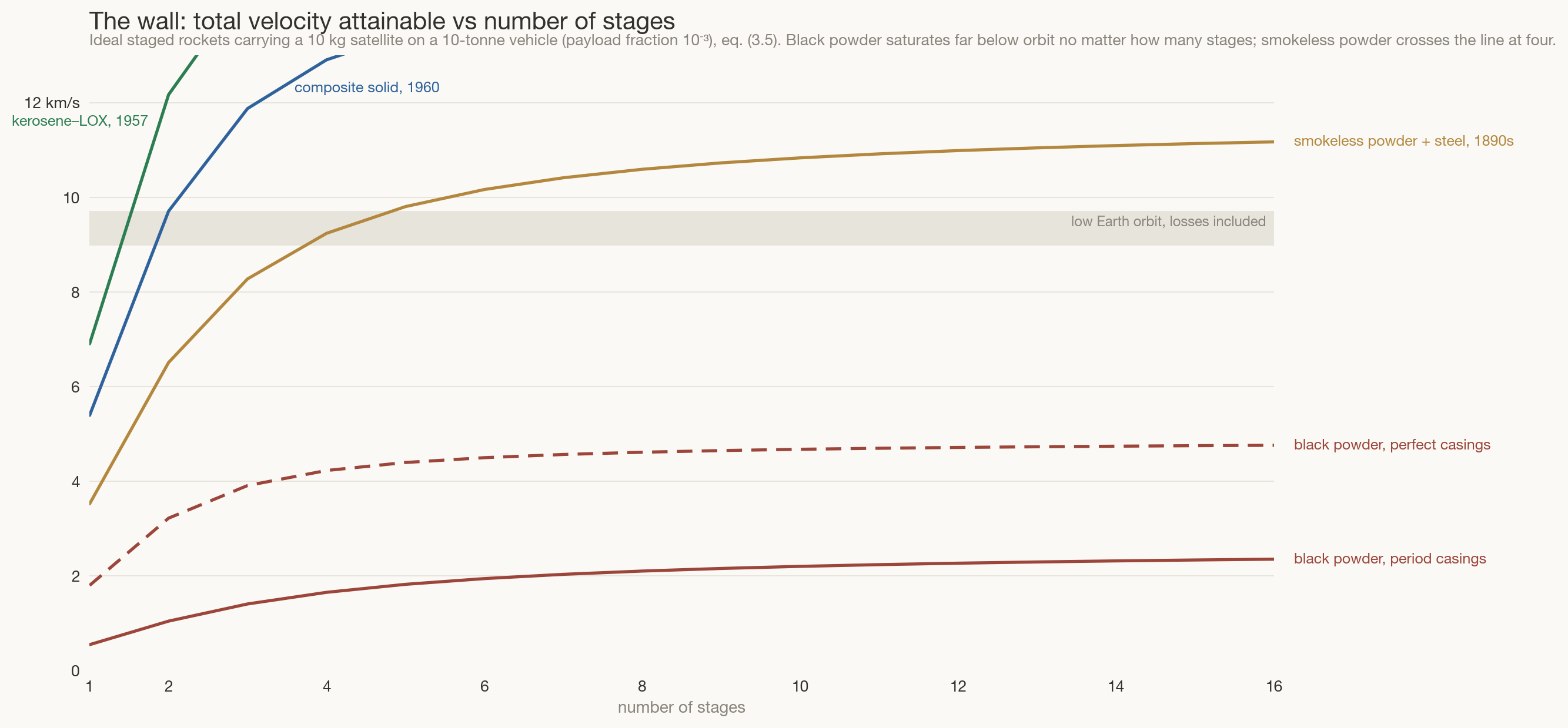
Figure 2. The wall. Total velocity an ideal staged rocket can
reach versus number of stages, carrying a 10 kg satellite at payload fraction
10⁻³, from eq. (3.5). Adding black-powder stages flattens out hopelessly below
orbit — the curve is asymptotic, not merely slow — while 1890s smokeless powder in
steel crosses the orbit band at four to five stages. The dashed curve grants black
powder anachronistically perfect casings and it still stalls near half the
requirement.
This chart settles the first historical question. The gunpowder
millennium never had a path to orbit. Not Song China, not Mysore, not
Congreve’s Britain — not for want of ambition or treasure, but because 0.7 km/s
of exhaust velocity cannot be staged, clustered, or financed into 9.4. Grant the
nineteenth century perfect casings and the ledger still demands about
650 million tonnes of black powder for ten kilograms of satellite.
The wall was chemical, and it stood for a thousand years.
Then, in five years, chemistry knocked it down — for reasons that had nothing to
do with space. Vieille gelatinised nitrocellulose into smokeless powder (1884) so
French rifles would outrange German ones; Nobel’s ballistite (1887) and the British
cordite (1889) followed. Double-base powders burn with two to three times black
powder’s exhaust velocity — roughly 2.1 km/s delivered through a proper
nozzle — and because sits in the
exponent, tripling it doesn’t triple the prospects, it transforms them:
9.4 km/s falls from thirteen exhaust-velocities to four and a half. And in a
tidy coincidence of the same decade, de Laval’s convergent–divergent nozzle (1888)
— invented for steam turbines — is precisely the device that converts a
propellant’s heat into that exhaust velocity efficiently.
III.The price of orbit, by chemistry
Run eq. (3.5) for a 10 kg satellite — a sphere with a battery and a
radio, Sputnik at seven-eighths scale — under each era’s chemistry and structures,
and the price list looks like this:
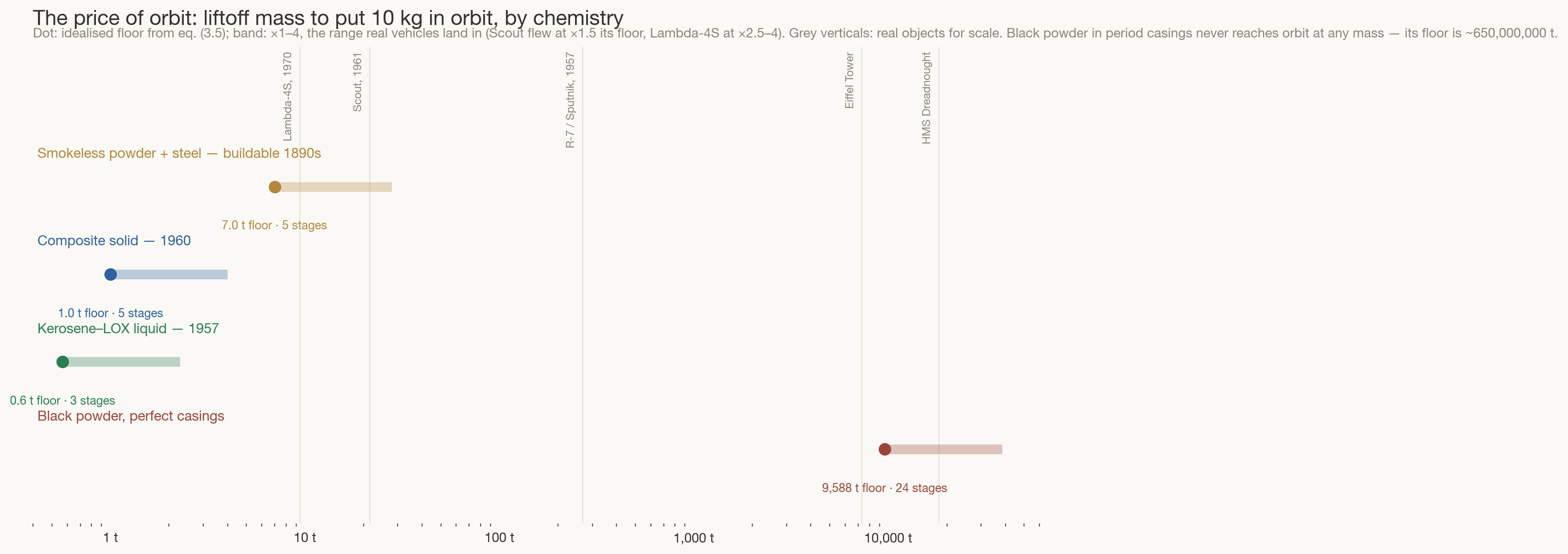
Figure 3. Liftoff mass to put 10 kg in orbit. Dots are the
idealised floor from eq. (3.5); shaded bands span ×1–4, which is where real
vehicles land (Scout flew at ×1.5 its floor, the unguided Lambda-4S at ×2.5–4).
Grey verticals are real objects for scale. The 1890s row is the finding: a
Victorian satellite launcher prices out at 7–30 tonnes — lighter than a
canal boat, in an era that riveted 18,000-tonne battleships.
Read the top row slowly, because it is the essay’s central number. With 1890s
double-base powder, 1890s steel, and a de Laval nozzle, five stages clear
9.4 km/s with a payload fraction around
:
a seven-tonne floor, call it twenty to thirty tonnes as built by people learning as
they went. That is not a Manhattan-Project object; it is one large boiler.
The same decade’s engineers were erecting the 7,300-tonne Eiffel Tower on schedule
and launching steel hulls a thousand times the mass of this rocket. Money and
fabrication were never the binding constraint after 1890; the constraint was that
no one asked.
The model is deliberately naive — equations (3.4)–(3.5) know nothing about
guidance electronics, interstages, or margin — so it is calibrated the honest way,
against vehicles that actually flew: Scout (1961, four solid stages, 21.5 t)
flew at 1.5× its computed floor; Lambda-4S (1970, 9.4 t) at 2.5–4×. The
Victorian claim inherits that band, which is why this essay says “twenty to thirty
tonnes,” not seven. The R-7 that launched Sputnik sits far off to the right at 267
tonnes — not because liquid fuel is heavy, but because it was an intercontinental
missile sized to throw a hydrogen warhead; the satellite was a passenger on a
weapon.
IV.The ingredient list
If orbit was affordable from the 1890s, the question “how early could a space
rocket have been invented?” becomes a supply-chain question: list every technology
an all-solid satellite launcher actually needs, and date each one’s arrival.
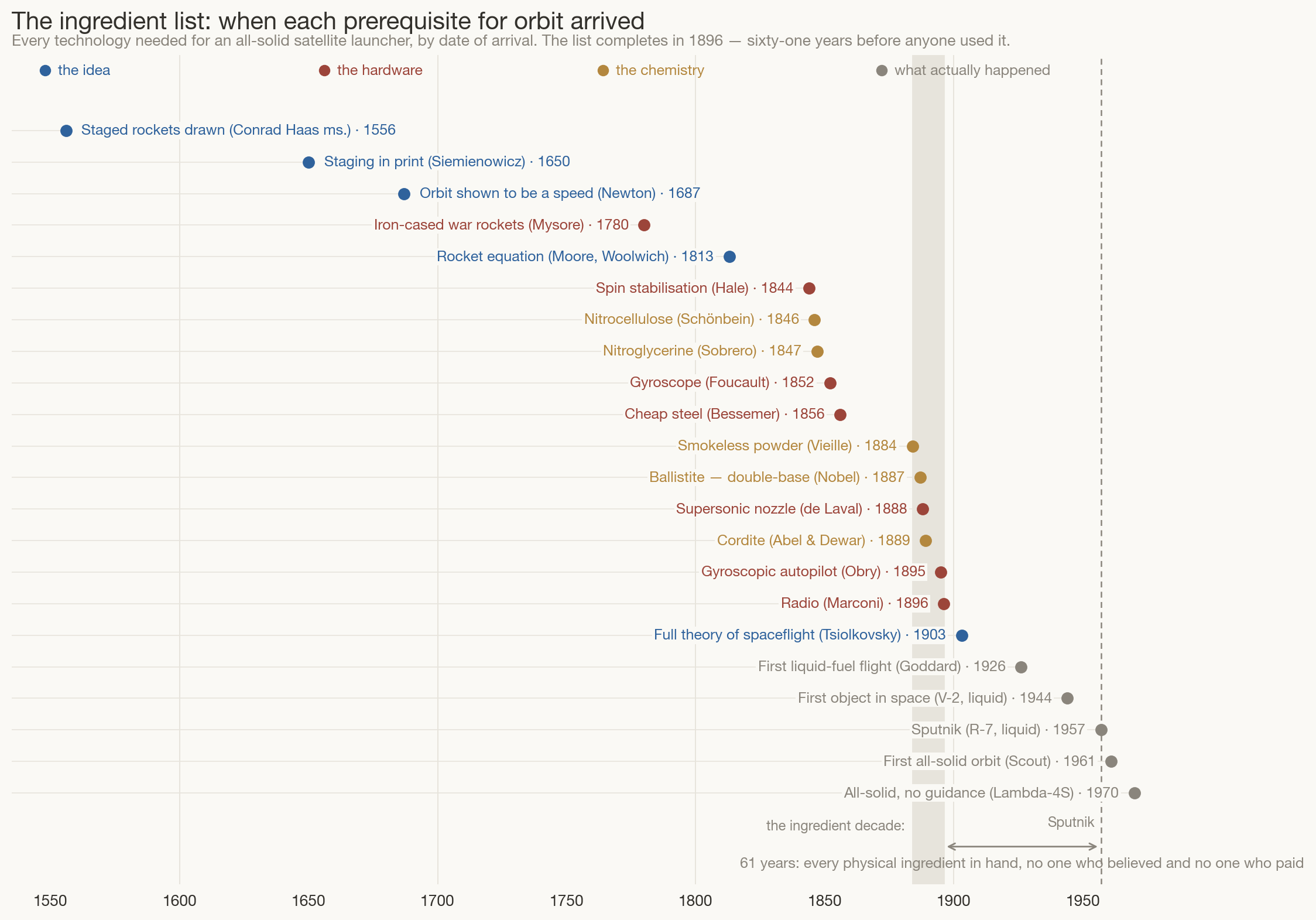
Figure 4. Arrival dates of every prerequisite. Blue: the idea
(staging, the orbital requirement, the rocket equation). Red: hardware (iron then
steel casings, spin stabilisation, gyroscopes, radio). Gold: the chemistry.
Grey: what actually happened. Twelve years — 1884 to 1896 — deliver the final four
ingredients, none of them invented with the sky in mind.
Three readings. First, the ideas are ancient relative to the
hardware: staging predates its chemistry by three centuries, the requirement
(Newton) by two, the rocket equation (Moore) by seventy years. Deep theory waited
on rifle propellant. Second, the enabling inventions arrive in a single burst —
smokeless powder 1884, ballistite 1887, de Laval nozzle 1888, cordite 1889, Obry’s
gyroscopic autopilot 1895 (already steering torpedoes, a guided missile of the
sea), Marconi’s radio 1896 (without which a satellite is unprovable — the last
ingredient is not propulsion but the ability to hear your success). By
1896 the list is complete. Third, the grey rows: from that completed list to
Sputnik is sixty-one years, and when orbit finally happened it
was reached with liquid engines built for warheads, then re-achieved within
thirteen years by solid rockets so simple (Scout, Lambda-4S) that they would have
been legible — component by component — to a good engineer of 1900.
Note what Figure 4 does to 1926. Goddard’s liquid-fuelled flight sits in
the grey rows, thirty years after the ingredient list closed — a landmark
of what came next (throttleable, restartable, high-energy engines; the road to the
Moon), not the opening of the door. The door had been standing open since the
1890s.
V.The existence proof from 1970
Counterfactuals are cheap; existence proofs are not, and this one is exact. On
11 February 1970, Japan’s Lambda-4S put the 24 kg satellite Ohsumi into orbit.
The vehicle: 9.4 tonnes, every stage solid-fuelled, spin-stabilised,
and — by deliberate national policy, to keep the university programme untouchable by
missile politics — flown without inertial guidance. A gravity
turn, a spin, one pre-programmed attitude nudge before the final burn, and physics
did the rest. It failed four times between 1966 and 1969 before it worked, which is
the honest footnote every counterfactual needs: nothing here says easy;
everything here says possible.
Walk Lambda-4S’s parts list against Figure 4. Solid propellant: 1890s
chemistry gets within ~15% of its performance. Steel and wound casings: Bessemer and
after. Spin stabilisation: Hale, 1844 — Victorian artillerists spun rockets as a
matter of course. Staging by timed pyrotechnics: fireworks masters, then
Siemienowicz. A radio beacon: Marconi. The only components a 1900 team could not
buy were the tracking radars that watched it — conveniences, not
requirements. That is the sense in which Goddard is a red herring: the first
satellite did not need his invention. Liquid fuel is what you need when you want to
orbit tonnes — people, cameras, warheads — cheaply and steerably. To make
a beacon exist in orbit, the solid path sufficed, and the solid path was open
decades earlier.
What would the Victorian programme actually have looked like? A 20–30 tonne,
five-stage stack of clustered cordite motors — the era could extrude cordite only in
sticks, so a first stage is thousands of sticks bundled in one steel chamber, or
dozens of Congreve-style unit motors ignited together: the programme’s hardest and
likeliest-fatal engineering problem, along with combustion instabilities nobody had
names for. Launch near the equator, spin the upper stages, sequence them with
clockwork fuzes, and listen for the beacon each pass. Optimistically — a competent
great-power arsenal starting in 1890 with Manhattan-style urgency — first success
plausibly falls around 1900–1910. Pessimistically, add a decade for the explosions.
Either way the physics had stopped saying no.
VI.Build your counterfactual launcher
Equations (3.4)–(3.5), live. Pick an era or set the dials yourself; the ledger
prices your rocket instantly. Drag the exhaust-velocity slider down to black powder
and watch the mass leave the chart — that cliff is the entire history of why
spaceflight waited for chemistry.
Figure 5 (interactive). Your launcher, priced by
eqs. (3.4)–(3.5) with
= 9.4 km/s.
The bar shows liftoff mass on a logarithmic scale against real objects; the shaded
extension is the ×1–4 engineering-reality band from Figure 3. Everything
computes in your browser; nothing leaves the page.
VII.Claims, carefully labelled as claims
Figures 2–5 are arithmetic from stated assumptions; what follows is
interpretation.
Goddard is a red herring for the question “how early?” Orbit never
required liquid fuel: Scout (1961) and Lambda-4S (1970) reached it on solids alone,
the latter without guidance. Liquid propulsion was the gate to heavy
spaceflight — people, platforms, the Moon — not to the existence of satellites.
Dating spaceflight’s possibility from 1926 mistakes the second story for the
first.
The true enabling invention was smokeless powder, 1884–1889. Exhaust
velocity sits in the exponent of the rocket equation, and double-base propellant
tripled it — the only jump in the whole story that turns orbit from forbidden to
affordable. Spaceflight’s chemical threshold was crossed by men optimising rifle
cartridges, and nobody noticed for sixty years — the de Laval nozzle (1888),
needed to cash the chemistry into velocity, arrived the very next year for steam
turbines.
The gunpowder millennium never had a path. With period casings, black
powder saturates near 2.4 km/s at any size and any staging (Fig. 2);
with impossibly perfect casings it still demands hundreds of millions of tonnes.
A Ming or Napoleonic space programme fails not on money or nerve but on
arithmetic. “Could rockets have appeared much earlier?” — as weapons, they did;
as space launchers, the answer is a clean no before ~1885.
Earliest plausible satellite: roughly 1905, give or take a decade.
A 20–30 tonne, five-stage clustered-cordite vehicle was within the fabrication,
budget, and instrumentation reach of any great-power arsenal from about 1890
(radio, the last ingredient — and the one that makes success audible —
arrives 1896). The hard parts (large solid grains, ignition simultaneity,
combustion instability) cost explosions and years, not new science: Lambda-4S
itself failed four times. Sputnik-style spaceflight sat ~50–65 years ahead of its
history.
The 61-year gap was demand, not capability. The requirement was
computable from 1687 and the means existed from 1896, yet orbit waited for the
hydrogen bomb to create a customer for 9,000-km rockets; the satellite rode to
space on a weapon’s budget. The rocket equation and the rocket factory had
already shared Woolwich for a decade in 1813 without speaking. The general lesson
for technological forecasting: arrival dates track incentives, not
possibility — and the interesting question about our own moment is which
ingredient lists are already complete, waiting for their H-bomb.
VIII.Method & honest caveats
The model is eqs. (3.1)–(3.5) and nothing more: ideal equal
-split staging with era parameters
( effective over the ascent /
): black powder 70 s / 0.45 in period casings (80 s
/ 0.10 in the counterfactually perfect ones); 1890s double-base 210 s / 0.18;
1960 composite 250 s / 0.11; kerosene–LOX 280 s / 0.08.
is fixed at
9.4 km/s; low-thrust-to-weight designs would pay more gravity loss and small
vehicles more drag, both of which push the Victorian estimate toward its upper band.
The idealisation omits interstages, guidance mass, and margins, so all results are
quoted as a floor with a ×1–4 band calibrated on Scout (×1.5) and Lambda-4S
(×2.5–4). The biggest honest uncertainties in the 1890s scenario are large-grain
manufacture (cordite extruded in sticks; monolithic cast grains are a 1940s art),
combustion instability (not even named until the 20th century), and unguided
dispersion — all engineering-iteration risks rather than physical barriers, but a
sceptic may fairly move my “~1905” to “~1915”. Injection precision is graded
generously: an orbit that decays in months still counts as a satellite here, as
Sputnik’s did.
History: dates and masses after standard references — Moore’s 1813
treatise (see W. Johnson’s commentary), Taylor’s and Sutton’s propulsion texts
for propellant performance, JAXA/ISAS records for Lambda-4S (9.4 t, 24 kg,
350×5,140 km orbit), NASA for Scout, and the usual encyclopedic sources for the
invention dates in Figure 4. Specific-impulse values for historical propellants
are necessarily approximate (black powder 60–100 s depending on formulation;
double-base 200–235 s delivered); the conclusions survive any value in those
ranges — the wall in Figure 2 moves by millimetres.
Charts generated by make_rocket_plots.py;
static versions: Fig 2 ·
Fig 3 · Fig 4
(each also as *_dark.png). The cannonball and the launcher lab are
computed live on this page from the same equations.