A pocket cliodynamics engine: two rival counterfactual
humanities — the Victorian satellite and the
sugar rocket — run four hundred times each, with and without the steam engine.
Build: one session (12 July 2026), ~80 minutes wall-clock ·
tokens (estimated): ≈2M in (cached context re-reads, chart inspection,
two model-debugging rounds) / ≈60k out (model, data, page, narrative) ·
model: Claude Fable 5. Figures are estimates from the session log,
not billing telemetry.
Two essays now disagree about why spaceflight came
late. Chapter 3 (mine) says the gate was a
customer: every ingredient existed by 1896, and orbit waited for the
hydrogen bomb to pay for it. The prompter’s companion essay —
Why Space Rockets Could have Happened
Sooner But Didn’t — says the gate was
vision: rocket candy (sugar + saltpetre, double black powder’s impulse,
zero new chemistry) sat unmixed for seven hundred years in the very cities where
Hasan al-Rammah wrote rocket recipes next door to sugar refineries, because nobody
wanted a motor. Rather than argue, this page builds the machine both claims can be
fed into: a dependency graph of forty-three technologies, lags calibrated so the
baseline reproduces real history, then perturbed — a vision event here, a deleted
steam engine there — and rolled forward four hundred times. Stephen Jay Gould asked
what would survive if you replayed life’s tape. This is that experiment for the
technosphere, at toy scale, with the assumptions in public view.
I.Two rival humanities, one falsifiable machine
Cliodynamics — Peter Turchin’s name for treating history as a dynamical system —
usually models states: population, elites, fiscal stress. Technology is harder,
because inventions look like one-off miracles. But chapters 1–3 of this site keep
finding the same structure beneath the miracles: a prerequisite
lattice (no smokeless powder without industrial acids; no de Laval nozzle
without something that rewards it) crossed with motive forces
(someone must conceive the thing, and someone must pay for it). That structure is
modelable. Each technology becomes a node; each node arrives some lag after its
prerequisites; vision and customers shorten the lag; substitutes let one
prerequisite stand in for another. History as it happened becomes the calibration
run, and each of our two theses becomes a named, disputable perturbation.
The four timelines this page runs:
A — as it happened. No perturbations. By construction its median
arrivals match the real dates; its spread shows how much luck the model thinks
was involved.
B — the Victorian satellite. Chapter 3’s counterfactual: a great-power
rocket program from 1890, injected as vision-and-customer multipliers on the
rocketry branch. An independent check on that essay’s arithmetic.
C — the sugar rocket. The prompter’s counterfactual: in 1250, someone
in the Mamluk Levant or Song China conceives the rocket as a vehicle and
mixes saltpetre with sugar. A sustained program follows, with spillovers into
chemistry, precision fabrication, and instruments — because motors demand
propellant science, tooling, and diagnosis.
D — the sugar rocket without steam. Scenario C with every steam node
deleted from the graph, forever. Can a civilisation reach orbit having never
built the technology our Industrial Revolution ran on? This is the prompter’s
question 2, taken literally.
II.The engine, in four equations
A technology i becomes buildable when every one of its
prerequisite groups is satisfied; a group is satisfied when any member has
arrived — substitutability lives in these OR-groups (Bessemer’s converter needs a
blast to blow it, but a waterwheel blows as well as a steam engine). The gate
is1
How to read it: is technology
j’s arrival year; is the year
i’s last prerequisite fell;
its base lag; a standard normal
draw, one per node per rollout, with = 0.14;
and
are vision and customer
multipliers, both 1 unless a scenario rule targets the node (a program that begins
after the gate accelerates only the remaining work — the lag integrates through
rate changes). Lags are calibrated so that scenario A’s median arrival
equals the real year for all forty-three nodes:
So the baseline cannot be wrong about history — it is history, with error bars.
Everything interesting is a difference from it. The last equation is the knife: to
measure what any single technology was worth, delete it and re-run
everything3,
One honest sentence before the results: this is a toy. It has one history to
calibrate on, its node list is a judgment call, and it cannot imagine paths its
author didn’t put in the graph. What it buys is not truth but
accountability — every disagreement with its output must name
the node, edge, or multiplier it disputes. The full graph, lags included, is in
timelines_data.js.
III.Four timelines, six milestones
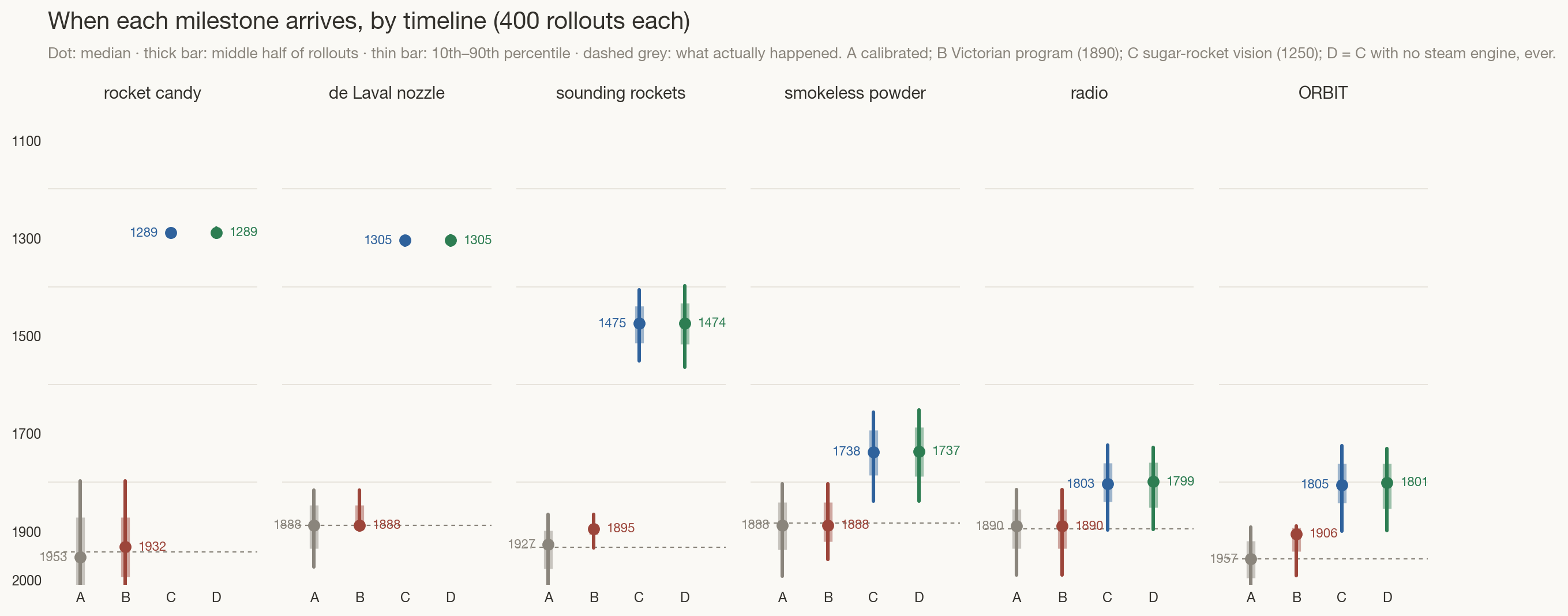
Figure 1. Arrival dates for six milestones under the four
timelines, 400 rollouts each; time flows downward. Dashed grey lines mark what
actually happened. In C and D the sugar rocket ignites in the 1280s and sounding
rockets fly around 1480 — yet the satellite still waits three more centuries.
Read column by column. Timeline B lands the satellite at a median of
1913 — an independent reconstruction of chapter 3’s
“1905 ± 10,” from a completely different method (that essay staged the
rocket equation; this one never once computes a Δv). Two models, one window;
that is as close to a cross-check as counterfactual history gets.
Timeline C is the surprise, and it cuts both ways. The vision event
works spectacularly at first: rocket candy by ~1288, an empirically-found
expansion nozzle by ~1305 (the model’s most heroic claim — flagged, disputable,
and exactly what the prompter’s draft argues iteration could deliver once the
propellant rewarded it), serious sounding rockets by ~1480. A medieval world
with a spaceward craft tradition, four hundred years of Congreve-class capability
before Congreve. And then the timeline stalls for three
centuries — because the satellite doesn’t need better rockets. It needs
industrial acids (median ~1690 even with the program’s spillovers), smokeless
powder (~1745), and above all radio (~1807), which waits on the
scientific-institutional stack — printing, societies, electromagnetism — that no
amount of rocketry accelerates. Orbit arrives at a median of
1808: seven hundred years of extra vision buys about a
hundred and fifty years of satellite.
Timeline D answers the steam question with an anticlimax that is the
point: delete every steam engine from the sugar-rocket world and orbit moves by
about ten years (median 1818, statistically indistinguishable
from C). The graph explains why: everything steam historically fed has a
substitute path — Bessemer’s blast blown by waterwheels, thermodynamics learned
from rocket motors instead of steam cylinders (Carnot studied the engine his
world had; a 1500s motor culture studies chambers and nozzles), compressors run
off internal-combustion engines that arrive by their own machine-tool route.
In the sugar timeline the steam engine is not a foundation; it is one lane of a
road that had several.
IV.Delete one technology from real history
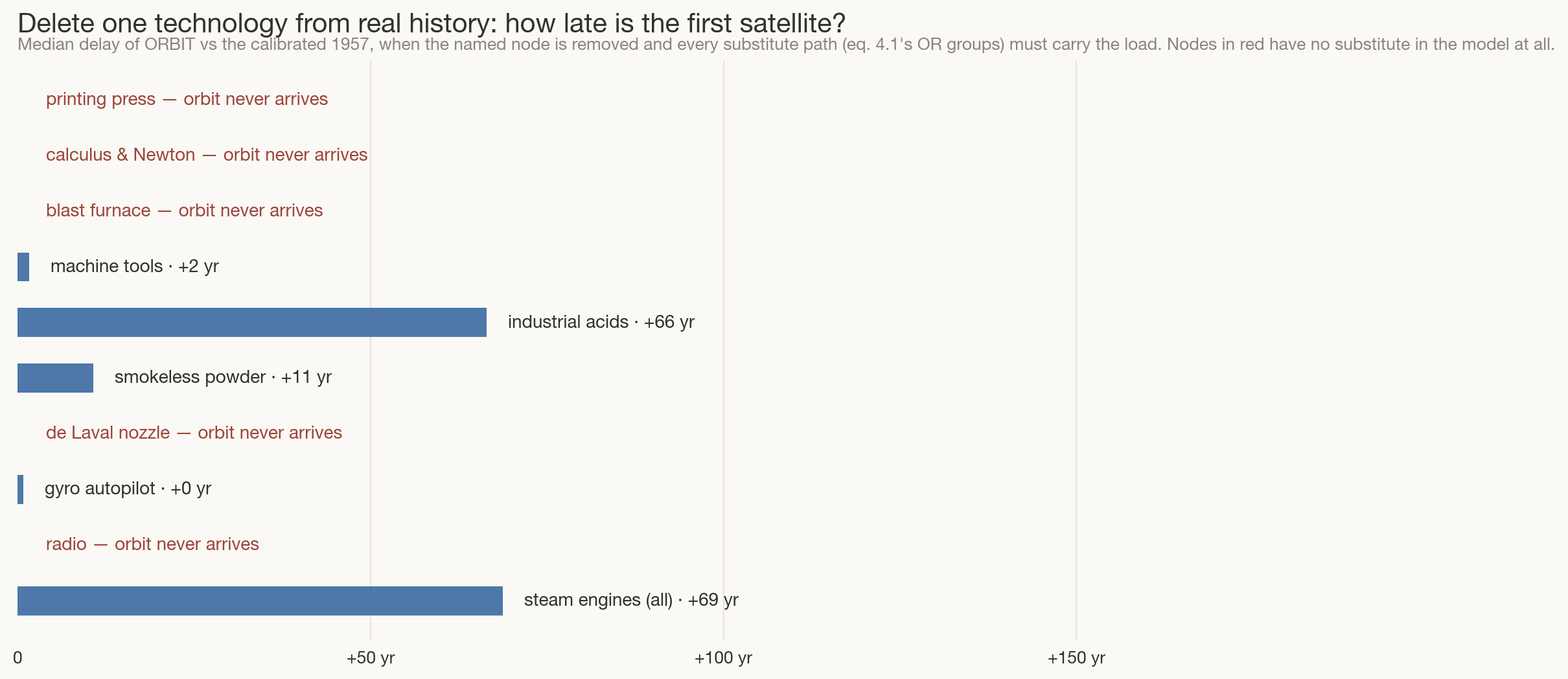
The same knife, turned on our own timeline: remove one node from scenario A,
keep everything else, and ask when the satellite arrives (eq. 4.4).
Figure 2. Median delay of the first satellite when one node is
deleted and the substitute paths must carry the load. Red rows are nodes with no
substitute in the model — delete them and orbit never arrives at all.
Three lessons in one chart. First, steam mattered enormously in
our timeline — about +71 years — but through an unexpected channel: not
factories, which the model routes around, but the de Laval nozzle, which history
happened to derive from steam turbines, and which a world without steam must wait
to discover through late solid-motor work. Steam was load-bearing in the timeline
that lacked rocket vision, and irrelevant in the one that had it (timeline D) —
the two answers to “how much does the steam engine matter?” are different because
the question was always about vision, not thermodynamics. Second, the red rows:
radio, printing, calculus, the blast furnace, the nozzle — the satellite’s true
single points of failure are mostly not rocket technologies. Third,
fragility runs both ways: give the model the prompter’s Essonne toggle (the 1788
chlorate disaster re-flipped as luck, below) and castable composite propellant
arrives decades early — yet orbit barely moves, because chemistry without a
program is inert. Vision without chemistry stalls (timeline C’s three-century
plateau); chemistry without vision molders on the shelf, exactly as perchlorate
did for 126 real years. Both essays were right, about different
halves of a conjunction.
V.Replay the tape yourself
The whole graph, live. Pick a timeline, then argue with it: drag the vision
event through nine centuries, throttle the program, delete steam, allow the
Essonne disaster to un-happen, or drop the requirement that a satellite must be
heard (radio) rather than merely seen. Every control re-runs 250
rollouts of eqs. (4.1)–(4.2) in your browser. (Prefer to inhabit one world
instead of surveying four hundred? The
Tape Machine plays single rollouts
as a year-by-year chronicle.)
—first satellite, median of 250 rollouts
Hover any node for its prerequisites and dates · whiskers span the middle 80% of rollouts
Figure 3 (interactive). The full 43-node dependency graph.
Rows are technologies grouped by branch; dots sit at each node’s median arrival
under your settings, whiskers span the 10th–90th percentile, and curves show
prerequisite edges. An × at the right edge means the node never arrives under
your settings. Data and calibrated lags:
timelines_data.js; nothing leaves your
browser.
VI.Claims, carefully labelled as claims
The engine is arithmetic from stated assumptions; what follows is
interpretation.
Vision is powerful and shockingly bounded. A vision event seven
centuries early delivers medieval sounding rockets (real capability, real
divergence) but moves the satellite only ~150 years, because orbit’s
long poles — institutional science, industrial chemistry, electromagnetism —
don’t care about rocket programs. The prompter’s thesis wins the suborbital
world; the lattice wins the orbital one.
The satellite’s critical path runs through Maxwell, not Goddard. In
every timeline this engine can produce, the last gate before orbit is the radio
stack (or the willingness to accept optical proof — flip that toggle and
timeline C’s satellite jumps to ~1741). Chapter 3 found this for one timeline;
it generalises: the hard part of a satellite is hearing it.
The steam engine was a route, not a foundation. Deleting it costs our
vision-poor timeline ~71 years (mostly via the nozzle it happened to gift
rocketry) and costs the vision-rich sugar timeline ~10. Answer to the prompt’s
question 2: yes — agents can skip the steam engine entirely and still
industrialise into orbit, provided something else (a motor culture) teaches them
thermodynamics and demands precision.
Two independent methods agree on the Victorian satellite. Chapter 3’s
staged rocket equation said ~1905±10; this dependency engine, which knows no
physics, says median 1913. When a bottom-up physical model and a top-down
structural one land in the same decade, the claim “orbit was ~50 years early”
deserves promotion from speculation to working hypothesis.
Neither vision nor capability suffices; history is their conjunction.
The Essonne toggle hands the 19th century castable composites and orbit barely
moves; the vision event hands the 13th century motors and orbit still waits on
acids and antennas. Every arrival in this model is a coincidence of a lattice
and a will. That is also its forecast for the present: the interesting
technologies of the next fifty years are the ones whose lattices are quietly
complete and whose Essonne-fears or missing customers are the only gate — which
is precisely where a vision event is cheapest.
VII.Method & honest caveats
The graph has 43 nodes and ~70 prerequisite edges, hand-chosen;
dates are standard reference values; lags are calibrated by iterated simulation
until scenario A’s medians reproduce the real years (the max over noisy gates
biases naive lags late, so calibration shrinks them; details in
make_timeline_model.py). σ = 0.14 was chosen
so that A’s 10–90% band on the satellite spans roughly ±70 years — wide enough to
be humble, narrow enough to distinguish scenarios. Programs multiply progress
rates only from their start date (a rule beginning after a node’s gate accelerates
only remaining work). The known sins: n = 1 — one history calibrates
everything, the founding critique of cliodynamics; graph closure — the
model cannot use a path its author didn’t draw, so “orbit never arrives” means
“not via these nodes,” not “impossible”; the 1305 nozzle — timeline C’s
empirically-iterated de Laval equivalent is the single most disputable edge, taken
deliberately from the prompter’s draft (pottery kilns evolved sophisticated
airflow without gas dynamics) and easy to disagree with by throttling the program
slider; institutions as nodes — “scientific method & societies” is a
1660 dot standing in for a civilisation-scale process; no reverse
causation — early rockets here never retard anything (no Essonne-style fear
events except the one modelled), though real history is full of technologies that
salted their own fields. Prior art, so this page doesn’t pretend novelty: Turchin’s
cliodynamics for the ambition; the Brian Potter / Marginal Revolution
“inventions-behind-their-time” analyses the prompter’s draft engages; tech-tree
games (Civilization) for the lattice intuition this page tries to make honest —
their trees are authored destinies, this one is a calibrated argument.
Figures generated by
make_timeline_model.py; static versions:
Fig 1 · Fig 2
(each also as *_dark.png); the interactive runs the identical model
from timelines_data.js. Companion essays:
chapter 3 (the customer thesis) and the
prompter’s Why Space Rockets Could have
Happened Sooner But Didn’t (the vision thesis) — this page is the argument
they have when they meet. And if the distributions here feel too bloodless, the
Tape Machine deals the same engine
out one world at a time: set the assumptions, press play, and live through a
single rollout year by year.